

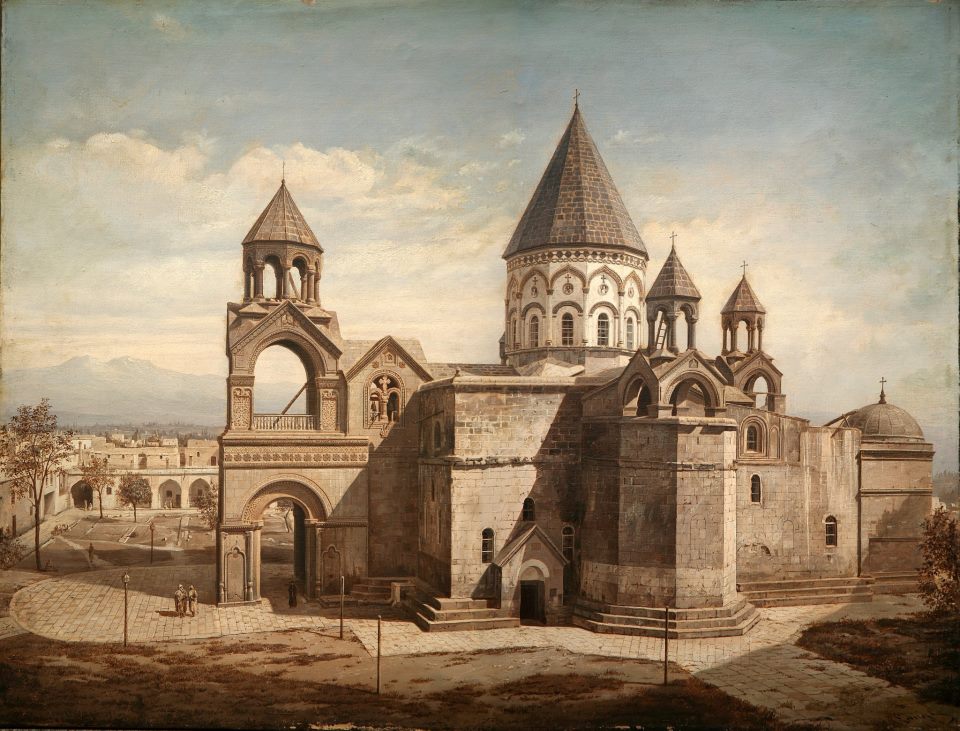
Etchmiadzin Mother Cathedral
Foundation (4th century)
The Mother Cathedral of Etchmiadzin took shape in the 4th century, when Armenia was among the first countries to adopt Christianity as a state religion. According to tradition, Saint Gregory the Illuminator has a vision in which Christ descends from heaven and strikes the ground with a golden hammer, indicating the place where the cathedral should be built.
From this, the name “Etchmiadzin” emerged, which literally means “The Only Begotten descended”.
Rebuildings and fortifications
In the 5th–7th centuries, the cathedral was rebuilt and reinforced several times, and under Catholicos Komitas I Aghtsetsi it received its main cruciform-domed volume, which has been preserved to this day.
From the Middle Ages to the new era
In the 17th century, the bell tower was built and other buildings of the complex were added, and in the 19th century, educational and cultural institutions were established, thanks to which Etchmiadzin was strengthened as the spiritual and cultural center of the Armenian people.
Modern period
Since 2000, the Mother Cathedral of Etchmiadzin and the adjacent churches have been included in the UNESCO World Heritage List, and the cathedral continues to be the residence of the Catholicos of All Armenians and the main sanctuary of the Armenian Apostolic Church.
Interesting facts
- Etchmiadzin is considered one of the oldest functioning Christian cathedrals in the world.
- The cathedral preserves important Christian relics and treasures.
- For centuries, it has been an important symbol of Armenian identity, faith, and statehood.
Etchmiadzin is not only a historical monument but also a living place where faith, history, and the present meet each other.

